

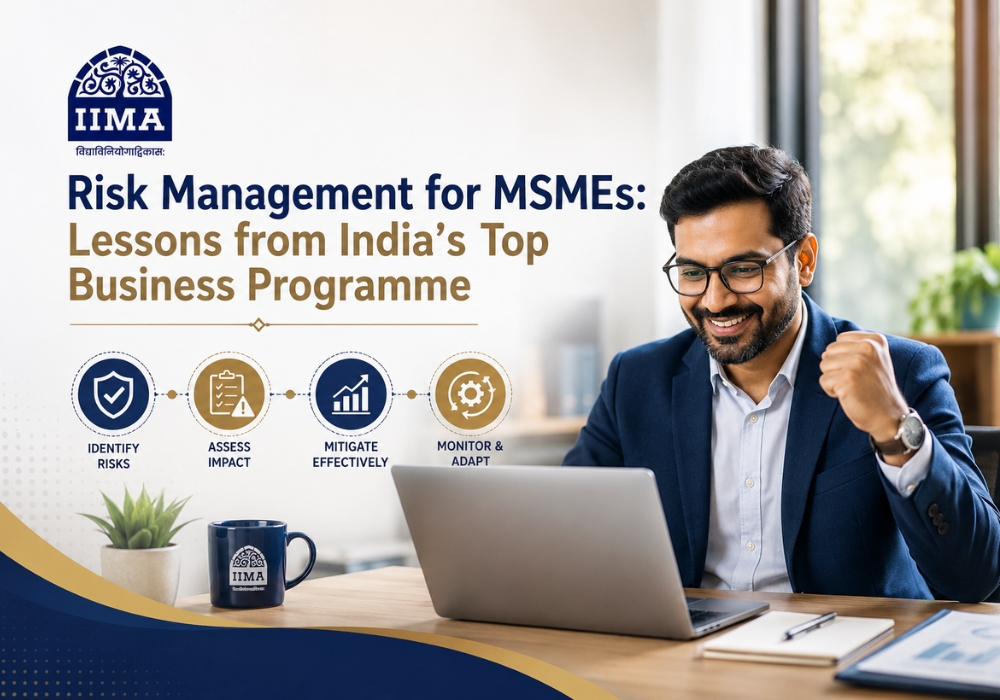
Micro, small, and medium enterprises have always been the backbone of India’s economy, and in the last two decades, the number of MSMEs has witnessed a huge increase, which have been contributing nearly a third of the country’s GDP and employing millions of people. Even after that, most of the MSME which have been growing into mid-sized companies get closed, not because of producing a bad product or having a weak market or supply chain, but because of poor risk management. In such cases, cash flow shocks, supply chain disruptions, regulatory changes, and leadership gaps can derail even a promising business overnight.
Considering such challenges, and for exploring reliable and effective solutions, risk management has become a core focus area in India’s leading executive education programmes for entrepreneurs. And one of the adequate examples is the LEAP Entrepreneurs’ Mentoring Board (LEAP-EMB), an MSME entrepreneurship development program, which has been designed and run by the Indian Institute of Management Ahmedabad (IIMA). It has been designed especially for business owners who want to move from running a company to building a well-known institution. The programme treats risk management as a discipline that sits at the heart of sustainable SME business growth.
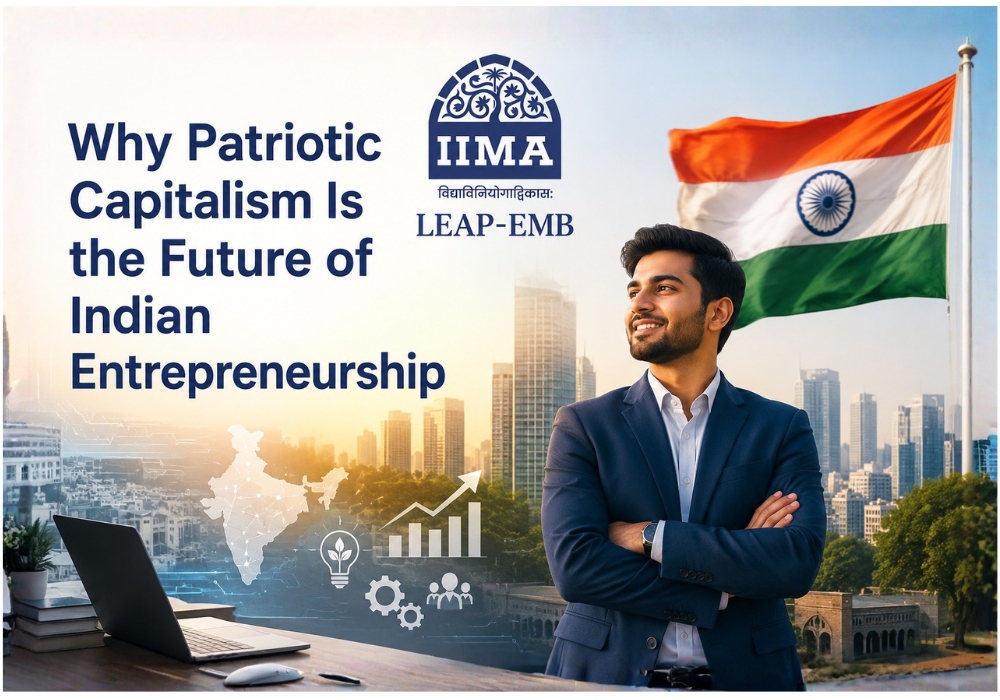
Go Through Our Latest Blog :- Patriotic Capitalism Is the Future of Indian Entrepreneurship
Why Risk Management Matters More for MSMEs Than Large Companies
It has been observed that large corporations already have dedicated risk committees, compliance teams, and deep cash reserves to absorb shocks and to manage such challenges. Whereas most of the MSMEs don’t have the infrastructure and a chain system for better management. There are several issues, such as a single delayed payment from a large client, a sudden spike in raw material costs, or an unexpected regulatory change can threaten the survival of a small business in a way it never would for a listed company.
This vulnerability is precisely why structured learning matters. Instead of learning risk management through trial and error.
Financial Discipline as the First Line of Defence
It’s one of the clearest lessons from IIMA’s programme structure, which says that risk management begins with financial management. Where, the curriculum’s financial and commercial management module mainly covers commercial management, investment basics, fundraising, capital structure, and risk management as an interconnected set of skills, and it is invariably related to the business model.
Some specific points reflect a broader truth for MSMEs, that is, unless you understand your numbers, you cannot manage risk. For that, entrepreneurs are encouraged to build the following practical insights, and these are like
- Tracking overall, working capital and cash conversion cycles, since liquidity crunches are the single biggest killer of small businesses
- Diversifying funding sources instead of relying on one lender or one large client. Because managing financial needs is always essential.
- Understanding the capital structure because debt must not become a burden during a slow quarter
- Building basic investment literacy so surplus funds aren’t left idle or mismanaged
Since financial discipline doesn’t just protect a business during a downturn, it also builds the credibility needed to raise capital when the business is ready to scale.
Strategic and Operational Risk: Thinking Beyond the Balance Sheet
Risks are confined only to financial and to understand this in a broader way, A well-rounded MSME entrepreneurship development program is designed to train founders to think about strategic risk, i.e., the danger of standing still while the market moves. Modules on design thinking for complex problems and disruptive innovation push entrepreneurs to constantly question whether their existing business model can survive changing customer expectations, new technology, or new competitors.
Similarly, operational risk is equally important. And many MSMEs are built around a single founder who handles sales, operations, and finance simultaneously. And such concentration of knowledge and decision-making is itself a risk. Programmes that focus on building high-performing teams, HR systems for scalability, and leadership development are, in effect, teaching risk management by reducing key-person dependency. A business that can function without its founder present for a few weeks is a business that has meaningfully reduced its operational risk.
Leadership and Mindset: The Overlooked Risk Factor
It’s easy to think of risk management purely in terms of spreadsheets and contingency funds, but leadership mindset plays an equally important role. Emotional intelligence, decision-making under pressure, and the ability to manage change are all part of how resilient founders navigate uncertainty.
This is why programmes built for institution builders are not just for entrepreneurs; it begins with what’s sometimes called “inner engineering”: mindfulness, emotional intelligence, time management, and a growth mindset. Therefore, for such a founder who reacts impulsively to a crisis, or who resists changing an outdated business model out of habit, introducing risk into the organisation regardless of how strong the balance sheet looks, it is essential to develop self-awareness and a structured approach to decision-making for them. And you will get insight into looking at all these easily with this program.
Peer Learning: Managing Risk Through Shared Experience
One underrated aspect of formal entrepreneurship programmes is peer learning. When MSME owners from different sectors come together in a cohort, they share real stories of what went wrong in their businesses and how they recovered. This kind of shared experience often teaches more practical risk-management lessons than theory alone.
So, hearing and sharing how another founder navigated a sudden loss of a key client or restructured debt during a slow year gives all the participants, entrepreneurs, a mental playbook they can adapt to their own situation. It also builds a network of trusted peers who can be approached.
Digital Transformation as a Risk Mitigation Tool
Modern risk management for MSMEs also has to account for digital risk and digital opportunity. Programmes that include digital strategy, business model transformation, and automation help entrepreneurs use technology to reduce operational risk, especially with better inventory tracking, real-time financial visibility, and data-backed decision-making, all of which reduce the chances of being blindsided by a problem that could have been spotted earlier.
At the same time, digital adoption introduces its own risks, from cybersecurity concerns to over-reliance on third-party platforms. A balanced approach treats digital transformation as both a growth lever and a risk area that needs ongoing attention.
Building a Risk-Aware Culture for Long-Term SME Business Growth
The biggest and most effective features of this program can be from how top business programmes structure their curriculum because risk management isn’t a one-time exercise or a checklist. It’s a mindset that needs to be embedded across finance, operations, leadership, and culture. Sustainable SME business growth doesn’t come from avoiding risk altogether — it comes from understanding which risks are worth taking, and building the systems, people, and financial discipline needed to absorb the ones that don’t go as planned.
For MSME owners looking to build this kind of resilience, structured executive education can offer real value. Programmes like IIMA’s LEAP-EMB combine financial management, strategic thinking, leadership development, and peer mentorship into a single learning journey — giving entrepreneurs the tools to not just survive uncertainty, but to grow through it.
If you’re an MSME owner or entrepreneur looking to strengthen your risk-management approach while building a scalable, future-ready organisation, exploring a dedicated MSME entrepreneurship development program can be a meaningful next step in your growth journey.
Conclusion
Risk management is one of the most essential factors for the long-term survival and sustainable growth of MSMEs. As a lesson from leading business programmes, LEAP-EMB shows that managing risk is not confined to financial planning but also includes leadership, operations, digital transformation, team building, and strategic decision-making. Therefore, by developing financial discipline, reducing dependency on a single person or source, adopting technology wisely, and learning from experienced peers, entrepreneurs participating in this program can prepare their businesses for all the expected challenges. Ultimately, sustainable SME business growth not only depends on avoiding every risk but on identifying, evaluating, and managing risks effectively while building a resilient and future-ready organisation.
Leave a Reply